Kisspeptin, testosterone and hormonal timing
The early hormone response is striking. Following the response through time makes the biology more interesting.
The measurements in healthy men
The early kisspeptin-54 experiment involved 6 healthy men and found stimulation of LH, with smaller rises in FSH and testosterone. LH is luteinizing hormone, a reproductive signal repeatedly measured in these studies. A later kisspeptin-10 study in healthy men found increases in LH, its pulse frequency and testosterone. These were responses under the reported research conditions.
The hormone results were enough to win my interest. They are specific, observable changes. Assigning a temporary rise the much larger meaning of an improved life feels like a serious overreach to me. The distinction has practical consequences for what a headline can honestly claim.
For the underlying signalling step, electrical recordings from mouse brain slices showed kisspeptin exciting GnRH neurons through a calcium-dependent pathway. That is cellular work in mice. It supplies a mechanistic piece of the account; the human hormone experiments supply a different piece.
LH pulses and the reproductive clock
A particularly absorbing experiment used kisspeptin as a timing probe. In healthy adult men, a kisspeptin-10 bolus induced an immediate LH pulse regardless of the timing of the preceding endogenous pulse and reset the hypothalamic GnRH pulse generator. Endogenous simply means produced within the body.
This experiment rescued the subject from the mental picture of a dial marked testosterone. Timing can itself be investigated. I enjoy that shift because it turns a vague ambition to increase something into a much sharper question about how a biological rhythm behaves.
The response also depends on the system being investigated. Patients with abiding idiopathic hypogonadotropic hypogonadism failed to produce the kisspeptin-evoked response seen in healthy men. The study used the response to probe the functional capacity of the GnRH neuronal network. That contrast between study groups matters whenever a finding in healthy volunteers is made to sound universal.
The response during repeated exposure
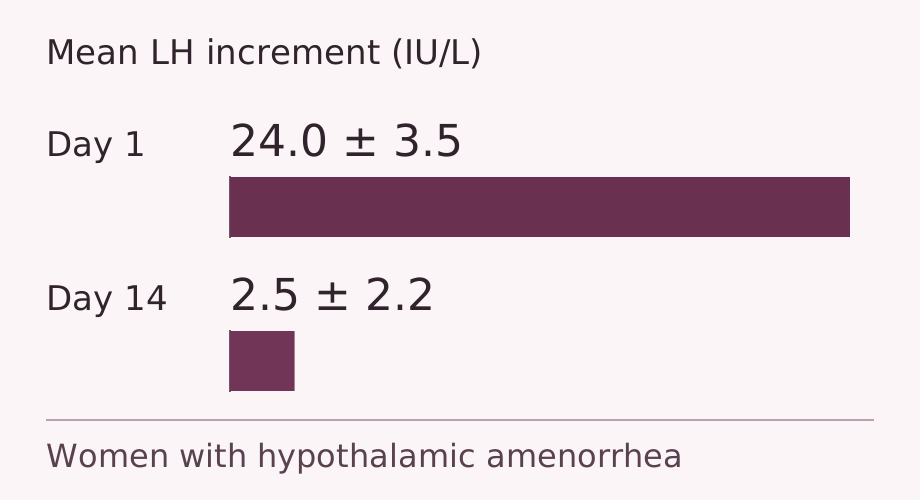
Here the population changes. In women with hypothalamic amenorrhea, the mean LH increment was 24.0 +/- 3.5 IU/L within 4 h on day 1 and fell to 2.5 +/- 2.2 IU/L on day 14 of repeated kisspeptin-54 administration. The paper calls the diminishing response tachyphylaxis. The chart preserves the reported values and their variability.
The scale of that change complicates any easy story about repeatedly stimulating the same pathway. This was a study in women with a particular condition. Extending its numerical result to men would go beyond the finding, but overlooking it would discard an important question about sustained exposure.
A separate infusion study in women with hypothalamic amenorrhea restored LH pulsatility while finding desensitization at the highest infusion rate. A review of KISS1R pharmacology describes desensitization, internalization and receptor recycling as influences on sustained or attenuated signalling. These give the fading response a biological context.
After an acute hormone response
The clock experiment has more staying power in my imagination than a simple testosterone headline. The response has a rhythm, a population and a history of exposure. Those features determine what kind of question an experiment has answered.
A newer delivery experiment adds another angle: intranasal kisspeptin-54 stimulated LH release in healthy men, healthy women and women with hypothalamic amenorrhea. Its immediate outcome was hormone release. The appeal of a different route can easily distract from the modest size of the question actually tested.
The next question is about experience. Sexual desire looks at a study that measured brain processing, a physical response and reported desire together. For me, that combination gives the wide view something tangible to work with.